

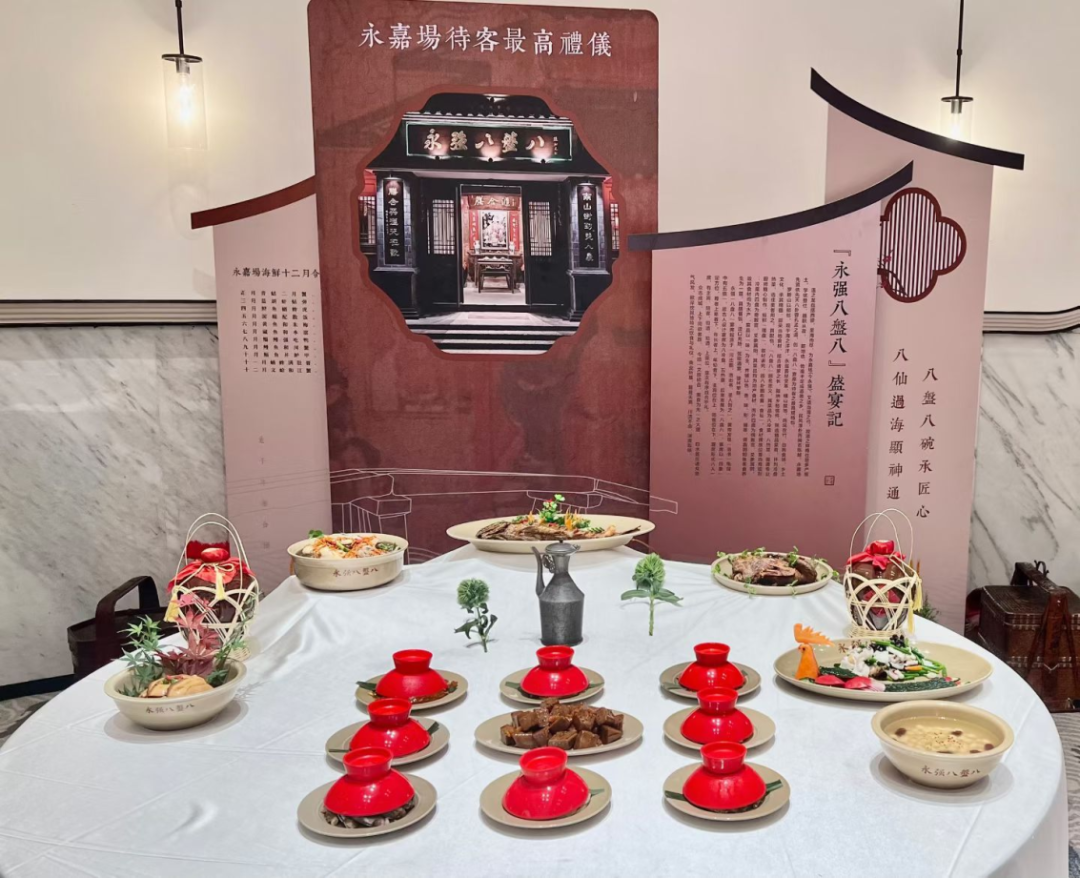
A table that divides the cosmos into land and sea. In Yongjiachang, Longwan District, traditional banquet hospitality takes the form of "Eight Plates and Eight Bowls" (Ba Pan Ba): eight cold appetizers paired with eight hot main courses, served to eight guests seated around a classic square Eight Immortals table. Today, this grand feast is inscribed on the Longwan District Intangible Cultural Heritage Register, and the Yongqiang "Eight Plates and Eight Bowls" Culinary Hall has been officially recognized as a Wenzhou Municipal Intangible Cultural Heritage Workshop.
The first mark of distinction lies in the strict geometric layout of the cold appetizers. The inner four plates are arranged in a central cross, featuring farm produce grown on the host’s land — steamed rice cakes (erbing), boiled white pork, dried eel fillet, and sweet white shrimp — representing the active element of yang. The outer four plates sit at the cardinal corners, featuring marine catches harvested by fishermen — fresh clams, dried cuttlefish, classic fish cakes, and smoked goose — representing the receptive element of yin. "A cross in the center, flanked by four corners": this sacred layout directly translates the ancestral Yongjiachang lifestyle onto the dining table — farming as the bedrock, complemented by coastal foraging. One side represents the fertile soil, the other the vast ocean; a single feast brings both worlds into perfect cosmic harmony.
The ten-legged taboo. Though Yongjiachang lies along the coast, blessed with an abundance of swimming crabs, mud crabs, and jellyfish, these "ten-legged" marine creatures are strictly banished from the traditional Eight Plates and Eight Bowls menu. In local folklore, these sea dwellers are revered as kin of the sacred dragon — the cosmic guardian of rain, wind, and ocean tides. Excluding them from the feast table is an act of profound humility and enduring respect toward the forces of nature.
Hot courses in a fixed order. The eight hot courses open with crispy sugar-glazed rice cakes — symbolizing "rising higher in rank and fortune with each passing year" — and conclude with a soothing sweet fruit soup. Between these two bookends flows a orchestrated sequence: "Family Reunion" seafood soup, braised pork belly with dried bamboo shoots, mud crab steamed with sweet potatoes, nourishing aged duck soup, scallion-oil yellow croaker, and typhoon-shelter prawns. Every single dish carries a profound proverb of blessing: the braised pork represents "The swine enters the abode, ushering in a hundred blessings"; the seafood soup signifies "Top honors in the triple examinations"; a whole roasted chicken promises "A hundred sons bringing boundless prosperity"; and a whole fish symbolizes "Abundance and good fortune year after year."
How to sit, how to serve, how to eat. The table must be strictly square — ideally an authentic mahogany Eight Immortals table — aligned along four cardinal sides so eight guests sit two by two. Seating follows an unbending hierarchy: the honored sit at the top, the humble below; elders above, youth below; the guest of honor at the head position, accompanied by host-attendants below. To commence the feast, the host gently slides the plate of steamed rice cakes to the exact center of the table — the plate must never leave the wooden surface, symbolizing that agriculture is the foundation of life, and one must never abandon the soil. As each hot dish arrives, the cold plates are returned to their designated geometric places. Guests partake in disciplined turns, taking one modest serving per round. When reaching into a shared plate, one is permitted to pick only from the side closest to oneself, eating methodically from the outer rim inward — "from the exterior to the interior."
It is through this deeply ritualized dining etiquette that the ancestors of Yongjiachang taught succeeding generations discipline, restraint, and social decorum. Today, while the feast has transitioned into modern culinary halls, those ancient rules — how to sit, how to serve, and how to eat — remain strictly and reverently observed.