

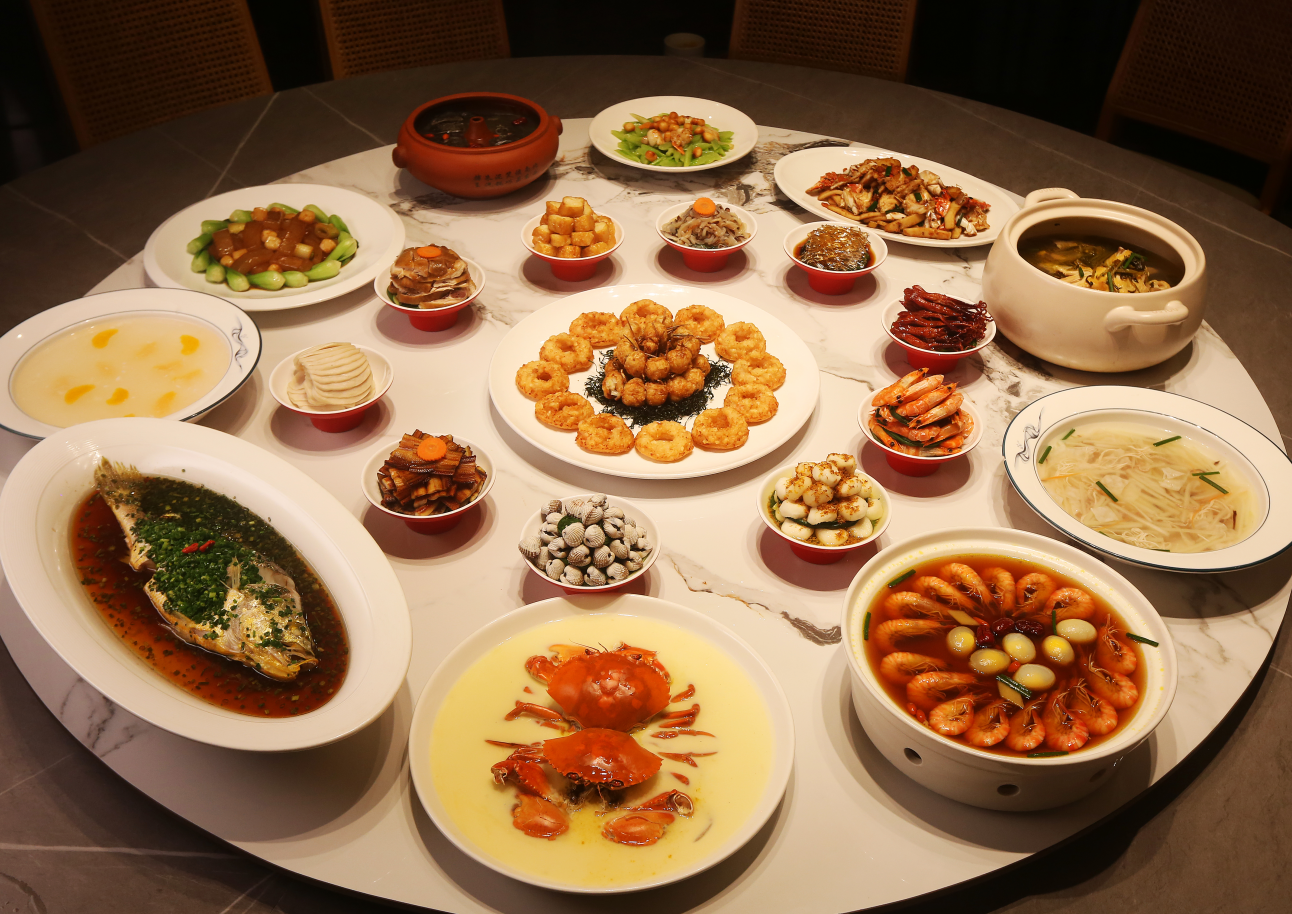
Most of China calls the New Year's Eve dinner a "reunion dinner." In Wenzhou, it goes by another name: Fensui Jiu, the "year-dividing feast." New Year's Eve is the dividing line between the old year and the new, and the name turns a single meal into the moment the two years part ways. "Fen" means to divide — the dinner itself does the dividing.
The feast opens with ten cold dishes, each served in a vermilion high-footed bowl. Ten stands for completeness: shiquan shimei, "perfect in every way." A thin round slice of red radish is laid on top of every bowl, a small charm for good fortune. The selection changes from house to house, but the familiar faces stay — dried soy sauce meat, white-cut chicken, duck tongues, dried eel, fish cakes, blood cockles, jellyfish, dried shrimp, chilled fish jelly, and Jiangxie Sheng, raw-marinated cut swimming crab in seasoned sauce.
Every cold dish says one line of blessing. The Wenzhou word for dried eel, xiang, sounds like the word for "thinking" — eat it, and children are expected to think more and work harder. Dried shrimp keep their heads and tails, a wish that things begin and end properly. Duck tongue is precious because each duck carries only one: "one in a hundred." Fish cake, pale inside and golden outside, means "gold and silver." Blood cockles, with white shells traced by fine lines, stand for a clean record and many open roads ahead.
Then come the ten hot courses, served in a fixed order that reads like wishes announced one after another. The first is always stir-fried rice cakes — nian nian gao sheng, "rising higher every year." A whole steamed fish follows mid-course, eaten head and tail intact, because "fish" (yu) and "surplus" (yu) are the same sound in Chinese; a local saying warns that no year is properly secured without a good yellow croaker. In a traditional spread the sequence runs: crystal rice cakes (rising year by year), braised pork with dried bamboo shoots (a red door that opens lucky), whole chicken with golden needles (a bright future), whole steamed fish (surplus every year), pig's trotters with pancai, a turnip-like winter root (wealth in every dish), braised fish maw (an explosion of good fortune), vermicelli with dried squid (ten thousand generations of long life), mixed delicacies (the whole family together), pounded fish soup with three shreds (a great harvest) — and the sweet finale, Eight-Treasure Rice or a soup of red dates and longan: "red and early in the new year," a wish for wealth to arrive soon.
Around the table there are rules. The family eats with the door shut and opens it only after the meal — "close the door to gather wealth, open it for good luck." A local legend holds that Tieguai Li, one of the Eight Immortals, walked the world on New Year's Eve to see who was rich and who was poor. And if a family member cannot come home, a seat is still set and chopsticks laid out, a custom called "adding a person to the table." The chair may stay empty; the person is not forgotten.
The feast does not end at home. Many Wenzhou people remember being taken, as children, to relatives' houses to eat Fensui Jiu, where the first hot course was always the same stir-fried rice cakes. House by house, the same bowls, the same order, the same wishes — the year-dividing meal travels through the family, so that no one is left out of the greeting.
For the people of Wenzhou, Fensui Jiu was never just dinner. Ten vermilion bowls, ten courses, a closed door, an empty seat set for someone far away — each element says the same thing: gather the people who matter, and say the important words over food. The meal divides one year from the next, and in doing so draws the family back together. It is food as ritual, complete.