

On a weekday morning, Wenzhou's Danan Produce Market springs to life long before the rest of the city fully awakens. Spanning approximately 13,000 square meters and housing 619 vendor stalls, the market stands on the historic site of the ancient "South Market" — once the bustling trading heart of the old walled city. Chen Jianlun has traded seafood here for over two decades; today, his stall specializes in sea cucumbers, having evolved from an open market counter into a polished storefront. In the local Wenzhou dialect, breakfast is called "tian guang" — literally "the sky's first light." For many residents, that daybreak arrives over a market floor glistening with fresh fish and shellfish.
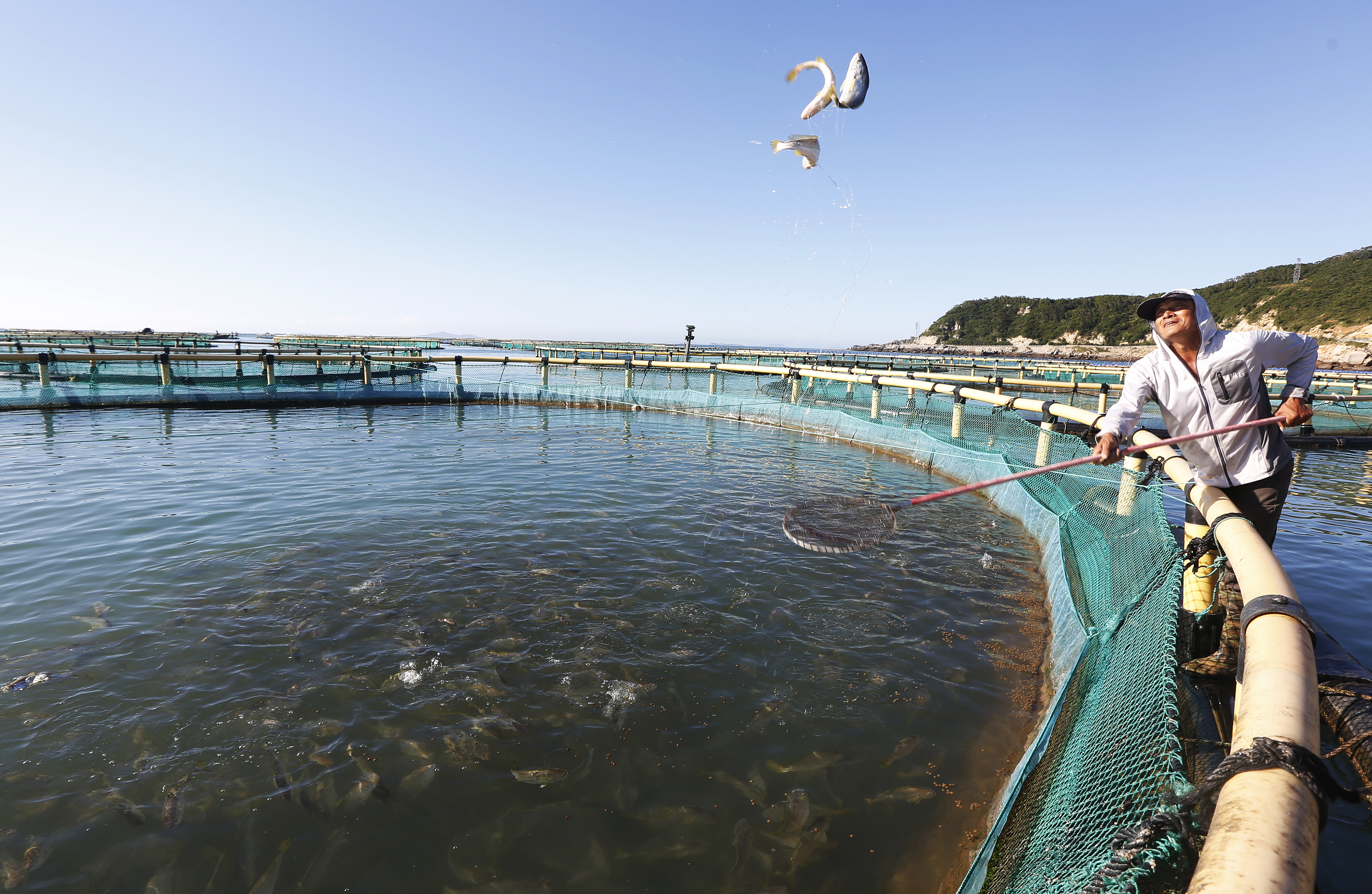
Most of this seafood arrives from waters just a few hours' travel from the city coast. The Nanji Archipelago, situated off Pingyang County, is a national marine nature reserve and the northernmost marine habitat in China where large yellow croakers can naturally overwinter. There, the warm Taiwan Current converges with the Zhejiang–Fujian Coastal Current, churning nutrient-rich waters that remain pristine year-round. Eleven aquaculture enterprises farm these surrounding waters using more than 1,000 mu (roughly 66 hectares) of deep-sea cages. In 2025, they harvested nearly 3,100 metric tons of yellow croaker, a fishery that sustains the livelihoods of nearly 95 percent of the islands' permanent residents. For a inland family, that fish might be steamed the very same evening — topped with shredded scallions and ginger, finished with a flash of scalding oil. As the saying in Ou Cuisine goes: "No banquet is complete without yellow croaker."
Farther north, off Luxi Island in Dongtou District, yellow croakers are cultivated through a pioneering method. A research collaboration including the Institute of Acoustics at the Chinese Academy of Sciences has engineered China's first "netless" ocean ranching facility: utilizing underwater sound wave barriers rather than physical netting, fish are retained in open waters at a natural density of approximately 0.2 fish per cubic meter, feeding solely on natural marine prey without artificial feed. By the end of 2025, the township’s yellow croaker farming area neared 2,000 mu (about 133 hectares). Along the nearby coast of Cangnan County, laver farmers have replaced traditional bamboo poles with eco-friendly fiberglass posts since 2022 — an innovation that prevents roughly 300,000 bamboo stalks from being submerged in the sea annually. The prized "first-crop" harvest, gathered between late November and December, is celebrated as the most tender and flavorful of the season.
Between the ocean tide and the dinner table, cooking techniques remain deliberately swift and minimal. Jiangxie Sheng — a iconic cold dish of raw-marinated East China Sea swimming crab — is chopped into pieces and steeped in a mixture of vinegar, soy sauce, and aged yellow rice wine for thirty to sixty minutes. No formal banquet in Wenzhou would dare omit this signature appetizer. Meanwhile, traditional Wenzhou fish balls are handcrafted from Mi-iuy croaker meat, scraped into irregular strips rather than rolled into neat spheres, and served in a delicate, crystal-clear broth. In 1998, this humble street food was officially designated a "Famous Chinese Culinary Snack."
The rhythm of the sea also dictates when Wenzhou gathers in celebration. When the annual summer fishing moratorium lifts in August, the peak seafood season arrives in tandem. On Dongtou Island, where seafaring families brought the Mazu worship tradition from Putian, Fujian, during the late Ming and early Qing dynasties, the goddess's birthday on the 23rd day of the third lunar month transforms into grand "Peace Banquets" spanning over a hundred communal tables. Twelve symbolic dishes carry blessings in their names: Whole Family Happiness (a simmering hotpot uniting seafood and fish balls) and Safe Voyage (a whole swimming crab steamed with its shell meticulously intact). In 2011, the Dongtou Mazu Festival was officially inscribed on China's National Intangible Cultural Heritage Register.
Wenzhou people name their daily meals after the arc of the sun — breakfast is "tian guang" (daybreak), lunch is "ri zhou" (midday sun), and dinner is "huang hun" (dusk). Yet the ebb and flow of the tide runs beneath all three. From the nutrient-rich currents of Nanji to the bustling stalls of Danan Market and the steamed fish gracing a family dinner table, the day's catch never travels far. That is precisely the point: the sea is close enough to be enjoyed at peak freshness, and ancient enough to be honored with tradition.