

Story
Wenzhou's ingredients are shaped by two distinct geographies: the East China Sea, where the Taiwan Warm Current meets the Zhejiang–Fujian coastal current, and the mountains of southern Zhejiang, where yam grows in Wencheng, tea wakes early in Yongjia, and mandarin trees have stood in Sanyang Wetland for a thousand years.
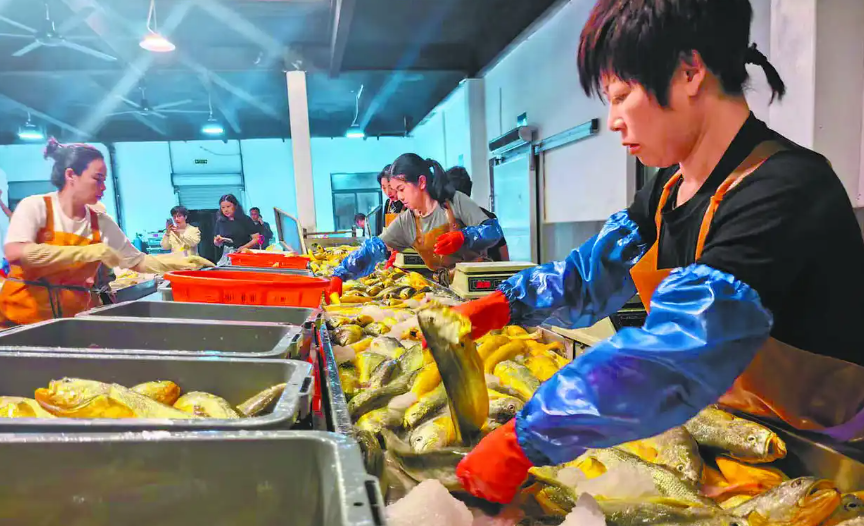
Nanji Archipelago — where yellow croaker overwinters. Nanji, an island group under Pingyang County, is China's northernmost marine area where large yellow croaker can naturally survive the winter. Water temperatures average 18–22°C year-round, and the convergence of two ocean currents creates a rich supply of natural feed. The classic dish is scallion-oil yellow croaker — steamed, topped with scallions and ginger, and drizzled with hot oil — giving rise to the Ou Cuisine proverb, "No banquet is complete without yellow croaker." The fish is at its plumpest in autumn during the osmanthus season; ferries depart from Aojiang Pier in Pingyang.
Luxi Island — fish raised behind a wall of sound. On Luxi Island in Dongtou District, fish farmers have replaced traditional nets with sound waves. Collaborating with the Institute of Acoustics at the Chinese Academy of Sciences, they built the nation's first "smart netless acoustic marine pasture": invisible underwater sound walls contain the fish inside a natural bay at a low density of just 0.2 fish per cubic metre, requiring no artificial feed. The fish's texture closely matches wild-caught quality. The highlight route: tour the marine pasture, savour an authentic yellow croaker feast, and stay in a seaside fisherman's home. Ferries run from Yuanjue Pier in Dongtou; the island is at its best from June to October.
Chixi, Cangnan — the laver that feeds the soup. Cangnan styles itself as China's "Hometown of Laver," with Chixi Town serving as its core production hub. Since 2022, the town has replaced traditional bamboo poles with fiberglass ones that last 8 to 10 years, saving 300,000 bamboo poles annually and keeping marine waste out of the water. The first harvest — the tou shui (first-water) crop starting in late November — is the tenderest and most umami-rich; Wenzhou households turn it into simple home-cooked dishes like laver soup, laver-and-egg soup, or savory laver cakes. From late November to March, the drying racks form a scenic "floating sea garden"; a viewing deck and seaside coffee house in Nantou Village allow visitors to taste fresh laver, gaze at the sea, and sip coffee all in one afternoon.
Wencheng — the sticky yam on the winter table. Wencheng County is the only place in Zhejiang Province that cultivates sticky rice yams at scale, a tradition spanning nearly a thousand years. Its main appeal lies in its texture: delicate, soft, and subtle with a gentle sweetness. The simplest classic preparation is steaming it to dip in white sugar; it is also braised with pork ribs or duck, or crafted into yam cakes and pastries. The prime consumption season runs from after Frost's Descent in late October through the Winter Solstice. Huangyang Village in Huangtan Town offers farm tours and yam-themed meals.
Yongjia — the tea that arrives ahead of spring. Yongjia's Wuniu Early Tea is one of China's earliest-sprouting varieties, hitting the market about a month ahead of West Lake Longjing and Dongting Biluochun — earning it the title "the first tea of early spring south of the Yangtze River." Harvested from mid-February to early April, the entire crop consists of pre-Qingming tea, the most prized harvest window. The liquor is clear and bright, with a fresh, vibrant aroma and a subtle hint of orchid. During the picking season, core tea plantations like Hengpaishan in Wuniu Subdistrict open their processing workshops to visitors to observe spreading, fixing, rolling, and roasting.
Sanyang Wetland — the mandarin with a bitter first bite. In the wetlands of Ouhai District, Ou mandarins have been cultivated for over a thousand years. Their flavor profile is rare among citrus fruits: sweet, but accompanied by an initial touch of bitterness — described by locals as "bitter first, sweet later." Fruit harvested around the Minor Snow solar term (late November) achieves its full flavor profile after about 20 days of storage, ripening just in time for the New Year season; the harvesting and stocking season lasts until around the Spring Festival. A cultural park in the wetland offers fruit picking, boat rides through reed marshes, and freshly squeezed mandarin juice.
What the map adds up to. Six areas, two worlds, one underlying logic: the freshness of Wenzhou cuisine endures because its ingredients strictly keep their own seasonal clocks. Yellow croaker in autumn, laver after November, yam after the frost, tea before spring, and mandarins right before the New Year. Eating by season in Wenzhou means reading the natural calendar of a coastal, mountain-and-sea city.