

On the industrial landscape of China’s large yellow croaker (Larimichthys crocea), Ningde in Fujian Province accounts for more than 80% of national production, with annual output of around 200,000 tonnes. In 2025, Wenzhou in Zhejiang Province produced 23,000 tonnes, generating 1.9 billion yuan in primary-industry output and ranking first in the province. Although Wenzhou’s output is less than one-tenth of Ningde’s, deep-sea large yellow croakers bearing the official National Geographical Indication Certification Trade Mark command 80 to 180 yuan per jin (500 g) — three to five times the price of conventional farmed croaker.
Behind this price gap lie two distinct aquaculture models and industrial strategies shaped by local marine conditions. Together, they illustrate a broader transition in China’s marine fisheries: from producing more to producing better, with a shift towards high-value deep-sea aquaculture.
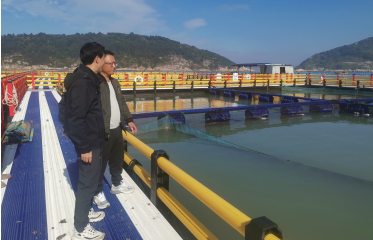
Two Divergent Paths: Industrial Scale vs. Deep-Sea Quality When discussing large yellow croaker in China, Ningde is an inescapable name.
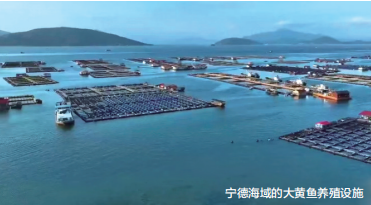
During the 1980s and 1990s, Ningde was the first to achieve breakthroughs in the artificial breeding of large yellow croaker. Taking advantage of the naturally sheltered waters of Sandu’ao Bay, local fishers rapidly expanded floating-cage aquaculture. Today, more than eight out of every ten large yellow croakers eaten in China come from Ningde. The real contribution of the Ningde model lies in its industrial scale and affordable prices — typically around 20 yuan per jin (500 g) — which have transformed large yellow croaker from a rare delicacy sold by the liang (50 g) into an everyday fish that ordinary households can afford.
Unable to match Ningde in output, Wenzhou chose a different path: instead of competing for scale and turnover in sheltered inner bays, it moved out into the open sea and focused on mid-to-high-end ecological aquaculture designed to emulate wild conditions.
As early as 2004, coastal Wenzhou was among the first areas in China to explore deep-water cage technology. According to contemporary public reports, Dongtou was then the only county-level jurisdiction in China to host three provincial-level deep-water cage aquaculture bases and projects simultaneously.
The relationship between the two regions is not an either-or contest, but one of division and cooperation along the industrial chain. In November 2019, 500,000 large yellow croaker fingerlings were transported from Fujian to the Bailongyu Ecological Marine Ranch in Luxi, Dongtou, where they were introduced to their new environment. Ningde serves as a major nursery and supplier for the mass market, while Wenzhou undertakes offshore ecological conditioning and quality enhancement. A single fish thus completes a strategic relay between Fujian and Zhejiang, moving from large-scale inner-bay farming to higher-quality deep-sea cultivation.
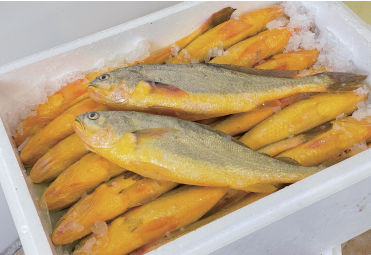
Marine Habitats: Calm Inner Bays vs. Turbulent Open Seas
The premium commanded by Wenzhou’s ecological large yellow croaker in first-tier cities and high-end restaurants begins with the stark contrast between the two regions’ marine conditions.
Ningde’s main farming areas are concentrated in bays such as Sandu’ao. Surrounded by mountains, these waters are calm and typically 8 to 15 metres deep, with dense clusters of cages resembling floating villages. In the gentle waters, large yellow croakers move little and expend less energy while feeding, reaching market size in just 8 to 12 months. The relative stillness of the inner bays, however, comes at a cost: the fish tend to carry more fat, have shorter and rounder bodies, and may be perceived by some consumers as having softer flesh.
Wenzhou’s main farming grounds, by contrast, are all located around offshore island groups: the Nanji Islands off Pingyang, the Beiji Islands off Rui’an and the Dongtou Islands.
These waters lie in the open East China Sea, at depths of 20 to 40 metres. The Zhejiang Coastal Current, the Taiwan Warm Current and local upwellings converge here, creating rough seas and strong currents, with peak tidal velocities reaching 1.7 metres per second.
“Farming fish here is like putting them in an open-air gym,” says a director at a deep-sea aquaculture base on Nanji Island. Large yellow croakers swim against the currents around the clock, burning off excess fat. Their bodies become long and slender, their muscles firm and their subcutaneous layer rich in gelatin. Once steamed, the flesh separates into distinct flakes resembling garlic cloves: sweet, springy and relatively free of fishy or greasy notes.
A Technological Leap: From Small Wooden Cages to an 800,000-Cubic-Metre “Acoustic Ranch”
In exposed offshore waters, equipment can determine whether an operation survives. This is where Wenzhou has opened up a technological lead over traditional farming areas.
Traditional inner-bay cages are relatively inexpensive, costing several housand to tens of thousands of yuan each. They depend on the natural shelter of harbours and can suffer heavy losses during severe typhoons.
Wenzhou’s offshore aquaculture, by contrast, requires substantial investment:
Deep-water gravity cages: The waters around Nanji use deep-water cages made from ultra-high-molecular-weight polyethylene. Each cage costs between 800,000 and 1.2 million yuan and has a circumference of more than 80 metres. Dozens of multi-tonne anchors and mooring lines as thick as an adult’s arm secure the cages to the seabed. This year, when Wenzhou’s coast was hit by the rare occurrence of three consecutive typhoons, most of the damaged facilities were reportedly conventional cages, while the region’s deep-sea intelligent aquaculture equipment withstood the strong winds and heavy seas without major damage.
Pile-supported net-free marine ranches: At the Jinfeng Marine Ranch on Luxi Island in Dongtou, 592 large steel piles have been driven into the seabed to support a “net-free” design. Large yellow croakers can dive more than ten metres to the seabed and feed on natural benthic organisms such as sandworms and small crabs. Acoustic fencing: The most innovative experiment is under way in Luxi Bay. Huangyudao Marine Fisheries Group, in partnership with the Institute of Acoustics of the Chinese Academy of Sciences, has installed acoustic equipment across a natural bay covering 160 mu. Taking advantage of the species’ physiological sensitivity to specific sound frequencies, the system uses underwater sound waves to create an invisible “fence” in place of physical netting. The large yellow croakers can swim freely through more than 800,000 cubic metres of natural water, retaining their golden colour and natural posture. The project attracted widespread attention after being featured on CCTV’s *The Code of Technology in Blue Granaries.
From small cages only a few metres across, to deep-water nets holding tens of thousands of cubic metres, and finally to an 800,000-cubic-metre acoustic ranch, Wenzhou is steadily exploring ways to return farmed large yellow croakers to conditions closer to those found in the wild.
Broodstock and Time: Daiqu Lineage and a Three-Year Slow-Growth Cycle The difference in texture also reflects a fundamental divide in broodstock and farming cycles.
Having industrialised earlier, Ningde relies mainly on the Mindong strain of large yellow croaker. After more than 30 generations of selective breeding, the Mindong strain is tolerant of rough feeding conditions, fast-growing and disease-resistant, making it well suited to high-density, rapid-turnover commercial farming. This is the genetic foundation that enables Ningde to support the national mass market through scale.
Wenzhou, drawing on the expertise of institutions such as the Zhejiang Marine Fisheries Research Institute, has instead pursued a strategy aimed at restoring wild characteristics:
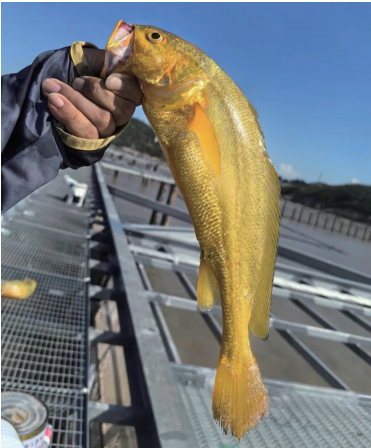
Broodstock:Farmers use offspring of wild Daiqu broodstock from the East China Sea, together with the selectively bred “27-vertebra” line. These fish retain typical wild characteristics, including pointed heads, red lips, elongated bodies and sturdy skeletons. Feed:Ecological farms do not use grain-based extruded feed. Instead, they feed the fish fresh natural prey, including small white shrimp, bighead croakers and small silver croakers, maintaining a food chain that closely resembles that of the wild.
Cycle:Commercial croakers in Ningde can reach market size in 8 to 12 months, whereas Wenzhou’s ecological large yellow croakers are slowly raised in deep-water cages for two to three years or more, enduring at least two winters of low temperatures. This extended growing period allows free amino acids and flavour compounds to accumulate fully in the muscle tissue.
As local fishers say, "Good craftsmanship takes time." That thousand-day wait is the decisive secret behind the fish’s concentrated flavor profile.
Branding and Standards: 236 Rules and “One Fish, One Code”
The offshore environment and heavy investment in equipment create the conditions for quality, while strict standards and brand management convert that quality into market value.
According to Wenzhou’s fisheries authorities, the city has formally issued the Full Industrial Chain Standard System for Large Yellow Croaker.
It brings together 236 current standards across 10 sub-systems, covering fingerlings, aquaculture techniques, disease prevention and control, testing, environmental management, packaging and cold-chain transport, and sales. The system is accompanied by the Technical Specification for the Quality Grading of Ecological Large Yellow Croaker. In response to cases in which low-priced fish from elsewhere were transported to Wenzhou waters for short-term holding and then sold as authentic Wenzhou ecological fish, Wenzhou’s fisheries authorities joined forces with the procuratorate and market regulators to establish a five-party judicial protection mechanism. The official position is clear: not every fish reared in Wenzhou waters qualifies as authentic Wenzhou Large Yellow Croaker.
At the time of the relevant statistics, only 10 enterprises had been authorised to use the “Wenzhou Large Yellow Croaker” National Geographical Indication Certification Trade Mark. Every compliant Wenzhou ecological large yellow croaker carries an anti-counterfeiting traceability code, with one code assigned to each fish. Consumers can scan the code to check the cage coordinates, broodstock source, feeding records and time of harvest.
Strict market access and quality control have lifted Wenzhou large yellow croaker out of low-price competition in the seafood market. According to industry insiders, farm-gate prices remain stable at 60 to 120 yuan per jin, while retail prices range from 80 to 180 yuan per jin (500 g). Premium fish weighing more than two jin (1 kg) can sell for several thousand yuan, and the product has established a regular presence at Sam’s Club and Freshippo, as well as on the menus of high-end restaurants in Beijing, Shanghai and Shenzhen.
A Never-Ending Co-opetition
On the shores of the East China Sea, Ningde and Wenzhou form the two wings of China’s large yellow croaker industry.
Ningde is the industry’s foundation. Its unparalleled output keeps large yellow croaker plentiful on everyday dining tables and has restored the species to a regular place in Chinese cuisine. At the same time, Ningde is advancing the development of broodstock, processing, branding and deep-sea aquaculture, while the benefits of its industrial development provide fundamental support for the large yellow croaker sector across the country.
Wenzhou is at the forefront of quality. With its offshore environment, modern technology and rigorous standards, it is exploring the upper limits of deep-sea, high-value aquaculture.
This competition has no end, nor does it need a winner. Through cooperation and competition between Zhejiang and Fujian, the large yellow croaker of the East China Sea, once brought close to extinction by overfishing, has not only returned to millions of Chinese family dining tables, but is also swimming towards a broader blue future.