Why does a local seaweed industry need an ocean-monitoring buoy?
Because laver is highly sensitive to water temperature — below 30°C it thrives, above that it sours and rots — and a buoy gives farmers real-time data to replace guesswork.
Temperature is the crop's lifeline. Laver seedlings are planted and nursed in the sea, and those early stages react sharply to small shifts in temperature, salinity and light. A stretch of warm weather can slow growth or ruin the harvest. Water-temperature control is therefore the key to a stable crop. Normally, after the solar term of White Dew, seawater temperatures normally begin to fall steadily and remain relatively stable. This year the pattern broke: El Ni?o has made temperature swings harder to predict, adding risk to seeding and nursing.
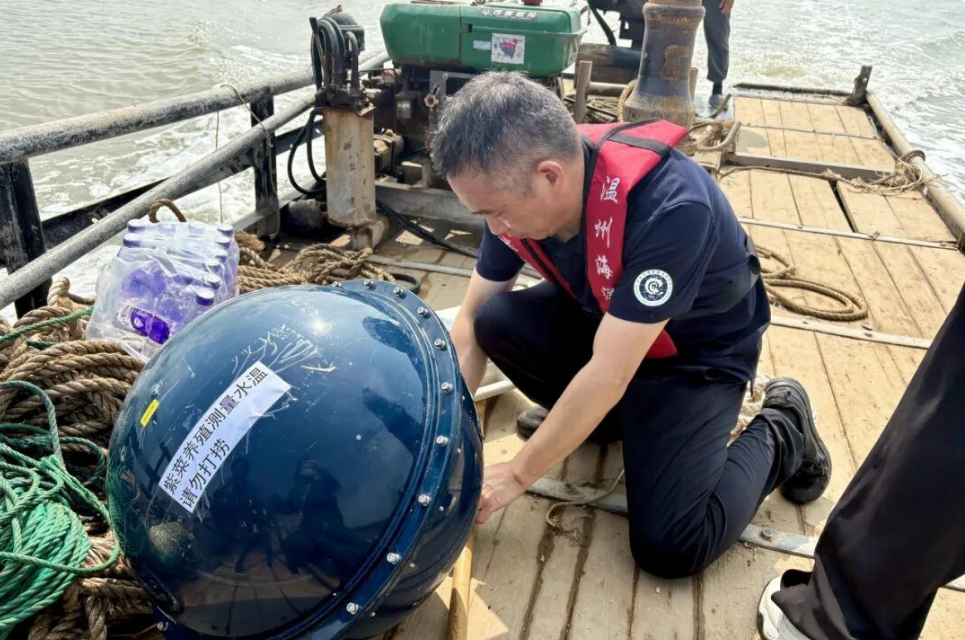
Put the thermometer in the sea. To close that gap, the Niyu Subdistrict and the Wenzhou Ocean Center of Ministry of Natural Resources set up observation buoys in the core farming areas — two new ones this year, in the northern and western zones — on top of buoys that have already monitored temperature here since 2023. The buoys measure real-time seawater temperature and cross-check it against forecasts, steadily improving the accuracy of both monitoring and prediction.
Make the number reach the farmer. Monitoring alone is not enough; the data has to get to the people tending the crop. The town now sends the readings to farmers straight away through two channels — messaging groups and text messages. "In the past we farmed by experience," says grower Lin Songhua. "Now real-time temperature lets us avoid risks in advance."
Ocean Center staff member Pan Xiaodong explains that the buoys capture accurate on-site readings and correct forecast precision against real observations, giving science-based farming reliable support. With the information reaching the shore quickly, the tradition of farming laver by feel is giving way, gradually, to farming it by data.
Dongtou reads its sea both as food and as an economy. A small floating buoy does not just guard a crop — it is how an island community turns the ocean's subtle signals into a safer, richer harvest.