

China's Ministry of Agriculture and Rural Affairs has included the "Yandangshan Dendrobium Culture System" on the eighth national list of China's Important Agricultural Heritage Systems. It is the first such designation in Wenzhou and one of three projects from Zhejiang included in this round. Behind the honor is a thousand-year journey: an herb whose cultivation began in the Northern Song Dynasty has grown into an industry spanning seedling production, cultivation, processing and medicine, with an annual output value of more than 7 billion yuan, while retaining the production area once praised as "the finest in Wenzhou."
How has a "celestial herb" whose cultivation began in the Northern Song Dynasty grown into an industry worth more than 7 billion yuan a year, and what can a national agricultural heritage designation add to it?
Answer in one sentence. By translating a thousand years of authentic local expertise into modern standards - including independently bred varieties, high-level science and technology platforms, quality standards covering the entire industry chain and deep processing - Yueqing has turned a regional advantage into an industry worth more than 7 billion yuan, rather than a museum piece.
A thousand years of "the finest in Wenzhou." Yueqing is one of China's main authentic production areas for Dendrobium. Written records of its cultivation date back to the Northern Song Dynasty, and its earliest recorded name appears in the Illustrated Supplement to the Materia Medica. Hand cultivation and Fengdou processing (Fengdou is dried Dendrobium stem rolled into a compact form) in Yandang, Dajing and Xianxi have a history of more than 500 years. By the Ming Dynasty, local people were already collecting, processing and selling Dendrobium and presenting it as tribute. The Qing Dynasty pharmacopoeia Bencao Congxin (New Compilation of Materia Medica) put it simply: "The sweet one is good; Wenzhou's is the finest." Yandang Mountain is the main production area for Wenzhou Dendrobium.
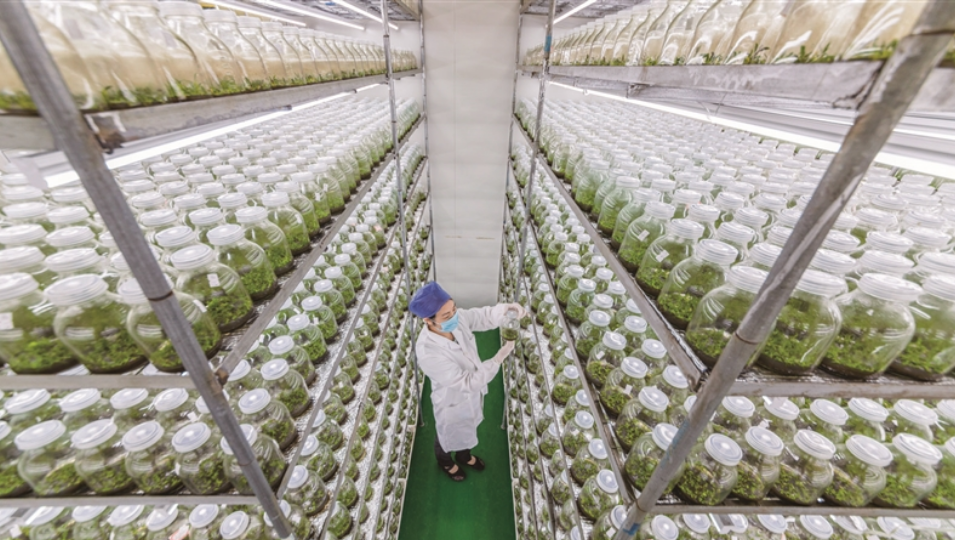
Owning the industry's "chip." Working with universities including Zhejiang University, Yueqing has independently bred five improved varieties based on local varieties, including the "Yanhu" and "Tiefeng" series, keeping local germplasm resources in local hands. The city now produces more than 600 million high-quality tissue-culture seedlings a year, accounting for more than 40 percent of the national market. Relying on high-level platforms including national key laboratories and academicians' workstations, Yueqing has undertaken more than 100 science and technology projects, including two under the national "Spark Program" and 16 provincial-level or higher research, development and demonstration projects. In March, Yueqing officially became a national agricultural seed industry base, joining the industry's "national team."
Standardizing the field-to-table chain. Yueqing has taken part in developing a standards system covering the entire Yandangshan Dendrobium industry. To date, it has completed two national technical specifications, nine relevant provincial and municipal standards, four county-level local standards and two provincial group standards, and issued more than 18 quality and safety supervision rules, ensuring that every step from field to table is governed by clear standards. The series of technical standards for Dendrobium production that the team helped develop won Zhejiang's Standard Innovation Contribution Award, and the Yueqing Dendrobium Science and Technology Courtyard was included on a national list.
A chain, not a single crop. The industry has developed into a complete chain covering seedling cultivation, planting, processing, sales and cultural tourism, with an annual output value of more than 7 billion yuan. It is Wenzhou's first agricultural industry chain to exceed 1 billion yuan in output value. The planted area now covers 13,000 mu (about 2,145 acres), including more than 5,000 mu (about 825 acres) under near-wild ecological cultivation. Fresh stems and Fengdou account for 30 percent and 80 percent, respectively, of national output. More than 200 new products have been developed around the herb, including snack foods, prepared dishes, alcoholic and nonalcoholic beverages, personal-care and skincare products, health products and medicines.
Earning a place on China's agricultural heritage list is not about putting the "celestial herb" in a museum. It is about turning a thousand-year-old advantage rooted in the local environment into a modern industrial advantage. In June this year, the brand value of Yandangshan Dendrobium was assessed at 3.812 billion yuan, making it one of four geographical indication regional brands from Zhejiang included on the national list. This celestial herb is not being preserved merely for display. It is being cultivated, standardized and sold, while the land that first praised it continues to receive the credit.