

Food bloggers from around the country taste the new-style Ou cuisine of Oujiangnan.
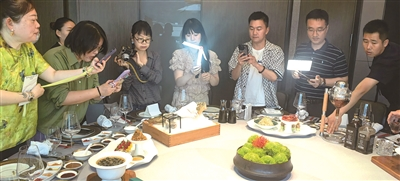
A river breeze moved through the evening and the south bank of the Ou glowed with colour. In June this year a gastronomic gathering called the Oujiangnan Summer Tasting Banquet opened its doors. Food bloggers and veteran eaters from all over the country arrived as invited, taking their seats at tables set along the water — the shifting lights of the river in front of them, the deepest flavours of midsummer at their backs.
An overture of appetisers, to wake the palate
Oujiangnan is a standard-bearer for new-style Ou cuisine in Wenzhou and holds both Michelin and Black Pearl honours. With a single summer tasting menu it presses the essence and the craft of Ou cooking onto one card, under a house motto that reads, roughly, “dare to be the freshest under heaven.”
The meal opens with a small, precise set of appetisers: cured white fish, pungent stems of pickled mustard, drunken sweet garlic, honeyed shreds of orange peel. Four little dishes climb from crisp and clean to savoury and saline, each carrying an old Wenzhou taste, and the guests’ palates open first.
Then Wenzhou’s raw river crab, jiangxiesheng, arrives and the bloggers’ chopsticks go to work. The roe is full and red, the meat sweet beneath its cure, the first bite ice-cold. This is the cold-dish headline in a Wenzhou heart — and, for plenty of food lovers from elsewhere, a “dark cuisine” dare. One guest remarked mid-meal that where Chaoshan raw marinades hit with a jolt, Wenzhou’s jiangxiesheng comes closer in texture to seafood ice cream.
Red-roe shrimp skin from the Grain-in-Ear solar term is paired with mi-iuy croaker aspic — one dry-savoury, one silky-cool, the two sea flavours lifting each other. Sesame-oil duck comes with soy-braised duck tongues, thick with sauce and toasted sesame, full of everyday warmth. Jellyfish, dendrobium flowers and mushroom “pomegranate” parcels bring crunch, a faint sweetness and a clean finish, each layer of flavour given its turn. The appetisers unfold like a scroll: the best of land and sea, and the taste of the season, revealed one panel at a time.
New-style Ou cuisine: dare to be the freshest under heaven
Large yellow croaker, croaker aspic, shark skin, soft-shell swimming crab. As these East China Sea specialities came out one after another, flashes began firing around the room.
Wenzhou’s local ingredients draw the boundaries and the character of its cooking; the Ou techniques handed down generation after generation turn the flavours of one stretch of land and water into a cultural and visual language.
“Buddha’s-hand conch blanched in clear chicken stock to release its sweetness; new-style home-braised large yellow croaker cooked with exact control of heat and time so the flesh stays tender, glossy and savoury; soft-shell swimming crab and small octopus braised in ten-year Huadiao; garlic-braised golden fish skin — these Wenzhou classics are the backbone of an Ou banquet.” The review, posted by the Nanjing blogger Huang Daxian Xunwei (“Old Huang Tastes the Country”), drew a stream of likes.
With more than five million followers across platforms, he added: “The new-style Ou dishes at this banquet were a surprise — minimal technique used to push the true taste of the East China Sea forward, in sharp contrast to the layered, carved logic of Huaiyang cooking.”
He Chen, a veteran restaurant critic and an ambassador for Hangzhou’s dining trade, came from Hangzhou to Wenzhou and followed “Wenzhou food” from home-style stir-fried small seafood all the way to the classics of Ou cuisine. The blogger Wusuowei, with more than a million followers, was not satisfied with the banquet dishes and the famous plates of Wenzhou’s big hotels: he planned to go after old-town street food as well — sticky rice, qiaoyu soup, Yongjia wheat noodles.
From the staple of seafood soy-sauce rice to the opening soup of Buddha’s-hand conch blanched in chicken stock, the dishes look plain, yet they sit on the palate as gently as Wenzhou’s own climate. From the garlic fish skin that broke out in 1983 to the new-style home-braised large yellow croaker that took a national cooking gold medal, the old flavours keep being restated by new-style Ou kitchens.
One banquet on the Ou drew bloggers from every corner of the country and from overseas. “In one sitting we ate the whole taste of Wenzhou’s mountains and seas,” one said. Another: “This is the local banquet most worth a special trip this year.” (Reporter: Zhaopu; photographs: Wei Wei)