

?When a classmate from out of town came to Wenzhou, she pulled up Xiaohongshu (a popular Chinese social media and lifestyle-sharing app).
It takes only a little over ten minutes to cross Huagai Hill. On a flat area halfway up is an open-air badminton court used by local residents. People practice tai chi and sword forms, dance, and gather to chat, filling every inch of the small clearing. In this backyard of old Wenzhou, watching the many rhythms of everyday life has a charm all its own.
I took my classmate over the hill to Gaoyingli, then turned into Tiejinglan. I wanted to show her the Iron-Railed Well, said to date from the Jin Dynasty, when Guo Pu laid out the city and “dug twenty-eight wells to represent the constellations.” It is the most beautiful well I have seen since childhood.
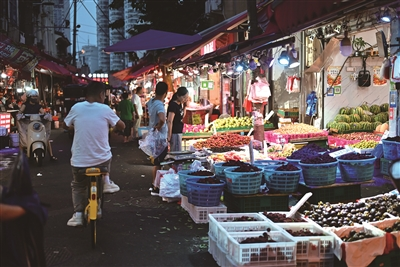
On our way back from Tiejinglan, we passed Gaoyingli Market. It was originally a children’s clothing market, but now connects seamlessly with Washi Food Market. With its open-air stalls, wide range of ingredients, and good value, it has become a popular market on social media, beloved by local residents and a favorite spot for visitors looking to experience everyday life in the city.
Leaving Washi Food Market, we walked along Jiefang Road and passed the irregularly shaped intersection on Guangchang Road. The area still has the seal-carving shops, opticians, print and graphics shops, and beauty and hairdressing equipment stores of the 1990s. Nearby, old buildings blending Chinese and Western styles face the World Trade Building in the distance. Here, old and new Wenzhou meet.
Along the way, we stopped at Changren Wontons and the Biantou shop selling dengzhanggao (a local savory fried cake) near the entrance to Gulou Street, then settled down at the Shantou Mai noodle shop on Jiefang Road. We ordered handmade wheat noodles with Wenzhou soy-braised pork, as well as jinfen noodles (local starch noodles) with Wenzhou-style pounded fish. We shared them in small bowls, savoring the old town’s flavors one dish at a time.
My classmate specifically wanted to visit Women’s Street. In the 1990s, Shamaohe was known mainly for hair salons, beauty services, and clothing shops. Today, it is a street of clothing shops and food stalls. We had just bought a bag of piping-hot chestnuts when we came across a vendor carrying malt sugar. The “ding-ding” of the vendor tapping the sugar drew us to a stop.
From Shamaohe, we made our way to the Wuma Street area, the true city center of Wenzhou. It preserves a row of century-old arcaded buildings that blend Chinese and Western architectural styles. At the entrance to Wuma Street, we turned into Caoxian Lane, where diners can find two hard-to-resist desserts: almond jelly and egg-beaten ice cream, a local dessert. The sign for “Yin Yi Yin” features a pair of sisters who seem forever young. The shop opened in 1985, and its interior has barely changed since the 1990s. It needs no makeover to attract customers.
The whole loop takes us through an area barely a kilometer across, yet it was the whole world I wandered as a child. We had planned to visit Wu Baiheng’s former residence to see The Old Wu Family House, where visitors can drink tea and watch a performance, but weekend tickets had already sold out. Perhaps leaving a little unfinished is a good reason for my friend to come back to Wenzhou. (By Ning Xi)