

At daybreak in Wenzhou, Zhejiang Province, while much of the city is still asleep, a supply chain for agricultural products is already quietly in motion. Freshly caught seafood arrives at market stalls, dew-kissed fruit and vegetables are arranged for sale, and steam begins to rise from freshly prepared rice and flour-based foods.
Every meal matters to the well-being of residents and the livelihoods of vendors. It also puts a city’s ability to stabilize prices and ensure reliable supplies to the test. Amid the bustle of everyday life, how does Wenzhou safeguard this essential foundation of people’s livelihoods? Recently, Chinanews.com visited several farmers’ markets and wholesale agricultural markets operated by companies under Wenzhou Modern Group to discover the stories behind the city’s freshest food supplies.
Finding Fresh Flavors at the Market, Preserving the Taste of the Coast
For many residents of downtown Wenzhou, the day begins at the Modern Food Basket Dananmen Farmers’ Market.
Fresh crabs, razor clams just brought ashore, gleaming large yellow croakers—the market offers an impressive array of locally distinctive seafood, reflecting the culinary wisdom of a coastal city that has long lived off the sea.
“Dananmen Farmers’ Market is large, offers a comprehensive mix of products and is known for its fresh seafood. It serves both families shopping for daily necessities and upscale hotels and restaurants sourcing ingredients,” said Zhuang Shenghong, deputy general manager of Wenzhou Food Basket Group Co., Ltd. With more than 600 stalls, the market offers a wide range of distinctive local ingredients.
Zhu Hailong, a military veteran, runs a shop selling pickled vegetables at the market. Early each morning, he arranges pickled mustard greens, pickled vegetable stalks and other products on his counter to welcome customers.
“My parents started this pickled-vegetable business, and I took it over more than a decade ago. Over the years, the market has helped us expand our sales channels. Our products are now sold to restaurants across the country and have become a recognizable taste of Wenzhou,” Zhu said.
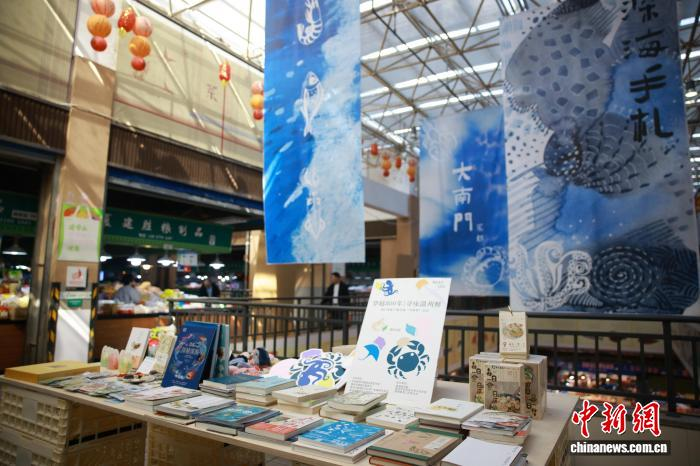
Dananmen Farmers’ Market in Wenzhou, Zhejiang Province, October 2026. Photo by Sun Yangyang.
The lively market serves more than local shoppers. It is increasingly a place where visitors from elsewhere discover the flavors of Wenzhou. In recent years, exploring local food markets has become popular with tourists, many of whom visit a market after sightseeing. Dananmen, located near Wuma Street, one of Wenzhou’s best-known shopping streets, has thus become a popular stop for visitors and social-media enthusiasts.
To make the most of this growing interest, the market has drawn on the history of the “South Market” in Wenzhou’s old city. It has organized themed events such as the “Books and Vegetables Season” and “Travel Through 300 Years to Discover Wenzhou’s Fresh Flavors,” incorporating ancient texts, the history of Ou cuisine and elements of Maritime Silk Road culture into the market experience.
As the market’s public spaces have been refreshed, its operations have also evolved with the times.
According to Zhuang, the company has launched a young-vendor incubation program to support the market’s transformation. Its “Voices of Young Market Vendors” new-media initiative features young stallholders and second-generation family-business owners. It also provides livestreaming facilities, entrepreneurial space and other resources to help aspiring young vendors pursue their goals.
“I worked and started a business away from home, but in the end I decided to return and take over the family trade. The market is completely different now from the old, noisy place people might remember,” said Gao Laili, a market entrepreneur born in the 1990s. Gao grew up helping his parents at the market and now manages several seafood stalls, with annual sales reaching more than 10 million yuan.
Each stall brings its own flavor, and tradition exists alongside change. Together, these everyday scenes give this food-loving city much of its character.
Bringing Produce from Across China to Household Tables
Unlike a farmers’ market rooted in a bustling downtown neighborhood, the Zhejiang Dongri Smart Agricultural Products Wholesale and Logistics Park draws its energy from produce and traders arriving from all over the country.
At 2 p.m., vegetable trading begins at the park’s wholesale agricultural products market, and the grounds quickly fill with trucks and customers. Zhou Tuanhui, a vendor originally from Jiangxi Province, calls out to buyers beside towering piles of peppers of different varieties.
“There are many types of peppers, and a great deal to learn about selling them. Thanks to my vegetable business, I have bought a home in Wenzhou and become a ‘new Wenzhou resident,’” he said. Most of the peppers he currently sells come from Weifang in Shandong Province and can reach consumers’ tables less than a day after being harvested.
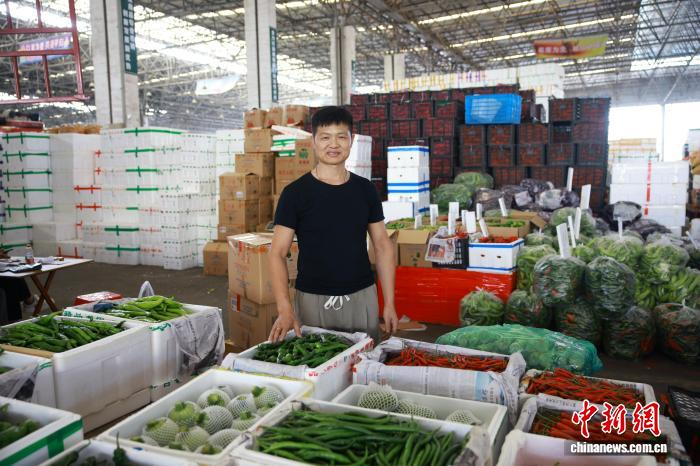
Vendor Zhou Tuanhui at his stall in Wenzhou, Zhejiang Province, October 2026. Photo by Sun Yangyang.
At nearby stalls, transactions are completed under the supervision of market trading agents. When goods are placed on an AI-enabled smart scale, the type of vegetable, weight and transaction value are instantly synchronized with a mobile app, allowing both buyers and sellers to check the information at any time.
“The park has more than 100 trading agents, and all transactions are registered under real names. If a problem arises, we can quickly trace its source and protect food safety,” said Huang Fuheng, deputy general manager of Zhejiang Dongri Co., Ltd.
Huang said the park is the largest distribution hub for agricultural products in southern Zhejiang and northern Fujian. More than 6,000 metric tons of goods are traded there each day on average. Vegetables, fruits, pork and aquatic products from across China arrive at the park before being sorted and distributed to households throughout the region.
Away from the trading floor, a food safety testing center helps keep the food supply safe. Inspectors collect produce samples from the market, bag them, attach QR codes and send them to a laboratory for analysis. Each sample carries a unique digital identity.
“Food safety has attracted growing public attention in recent years. We regularly update our list of high-risk product categories, with particular focus on items that prompt frequent feedback from consumers,” said the head of the testing center. The pass rate for goods tested at the park has remained around 99 percent. Its in-house food safety system is also connected to Zhejiang’s “Zhe Shi Lian” food traceability platform, creating a closed-loop management system in which the origins and destinations of products can be traced, safety can be verified and problems can be investigated.
As night falls, the final link in the park’s agricultural supply and distribution chain begins another busy shift.
Workers take their places and the fully automated sorting line at Mapai Fresh starts running. Operations begin at around 9 p.m., and the meat, eggs, fruit and vegetables selected and processed overnight can be delivered to schools, businesses and residential communities by the following morning.
“In the Wenzhou dialect, ‘Mapai’ sounds like the phrase for buying groceries. It is a familiar name that people can easily remember,” said Jin Gangjian, deputy general manager of Wenzhou Food Basket Distribution Company. The team has established a standardized sorting facility, upgraded its smart information system for fresh-food delivery and its ready-to-cook vegetable processing workshop, and is exploring new forms of fresh-food retail.
Working around the clock, 365 days a year, the steady stream of trucks carries far more than agricultural products. It sustains the countless everyday meals that make up life in the city.
Well-Stocked Granaries, Stronger Food Security
How many different types of rice are there?
Glutinous rice, indica rice, japonica rice and more. At the Wenzhou Grain Central Market, Dong Zebing, who has traded in grain and edible oils for many years, is happy to explain the differences. “In the past, most people thought only of ordinary white rice. As diets have diversified, the choices available to households have become much more varied,” he said.
Behind this growing variety, digital technology is helping the grain market navigate changing conditions. At the market’s online grain trading information center, a large smart display shows real-time grain prices and trading volumes across local districts and counties, making market trends easy to follow.
“Keeping prices stable and supplies sufficient is the grain industry’s bottom line. We must make good use of market forces and continuously strengthen the market’s resilience to risk,” said Zhao Xianguang, deputy general manager of Wenzhou Grain Industry Group. The market handles approximately 600,000 metric tons of grain transactions a year. In 2026, a joint grain auction platform linking Wenzhou, Suzhou and Fuzhou began operating, further extending the market’s reach.
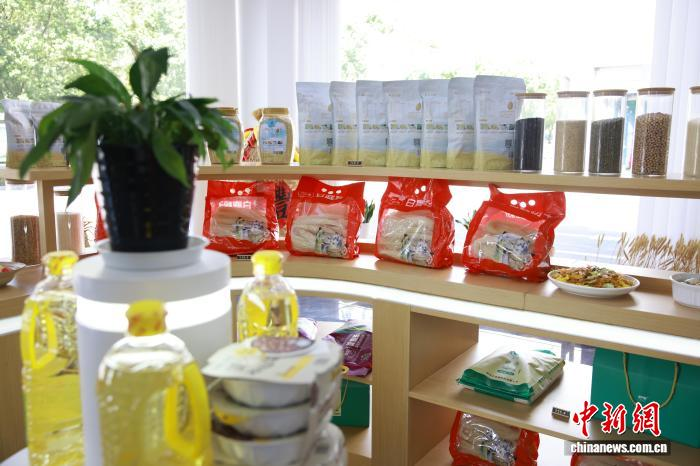
A display of “Wenliang Select” products in Wenzhou, Zhejiang Province, October 2026. Photo by Sun Yangyang.
Grain connects the year-round harvests of farmers with the daily meals of urban residents. As the market transforms, Wenzhou Grain Industry Group is developing new commercial products and services to help advance common prosperity.
For example, it has established the online “Wenliang Mall” and brick-and-mortar “Wenliang Select” stores. It is also processing distinctive agricultural products into higher-value goods and developing ready-to-eat mixed-grain rice and low-glycemic-index grain meals to meet growing demand for convenient, healthy food.
Stable grain supplies are essential to people’s well-being. With limited arable land in Wenzhou and surrounding areas, food security is particularly important. At the Panqiao Grain Depot, far from the city center, cylindrical silos rise among green hills, supporting the city’s grain reserves and emergency supply capabilities.
Toward evening, trucks loaded with golden rice grains are still arriving at the depot. Jin Weibo, the depot’s deputy director, operates a drone system to inspect the grounds.
“We used to rely entirely on staff patrols, and even when I was off duty, I could not sleep soundly at home. Now the smart inspection system gives us another pair of eyes around the clock,” said Zheng Xiaoyue, deputy general manager of Wenzhou Grain Storage and Procurement Company. Smart equipment can cover areas that are difficult for staff to reach, greatly improving inspection efficiency.
Four-legged robotic dogs patrol the depot, autonomous inspection vehicles travel along its routes, and smart systems adjust temperature and humidity inside the warehouses in real time. According to Jin, the integrated technology allows processes from sample testing to grain intake to run more efficiently. This AI-enabled “granary of the future” makes grain storage and management more precise and less labor-intensive.
From bustling markets to granaries nestled in the hills, Wenzhou is steadily strengthening a round-the-clock supply network linking the city’s “vegetable basket,” “fruit basket” and “rice bag.”
By preserving the vitality of its markets, embracing digital innovation and safeguarding the food on people’s tables, the city is showing how a modern agricultural distribution system can help secure the foundations of everyday life.