

On an autumn night along the Tanghe River, the flowing sleeves of Ou Opera sweep past stalls of tea ware. Before the aria fades away, the beats of world music drift over on the river breeze. A French artisan traces the grain of Ou kiln pottery with his fingertips, while a local elderly woman points to a bamboo tea scoop and tells her grandchildren old tales of felling bamboo and making paper deep in Zeya Mountain…
On an autumn night along the Tanghe River, the flowing sleeves of Ou Opera sweep past stalls of tea ware. Before the aria fades away, the beats of world music drift over on the river breeze. A French artisan traces the grain of Ou kiln pottery with his fingertips, while a local elderly woman points to a bamboo tea scoop and tells her grandchildren old tales of felling bamboo and making paper deep in Zeya Mountain…
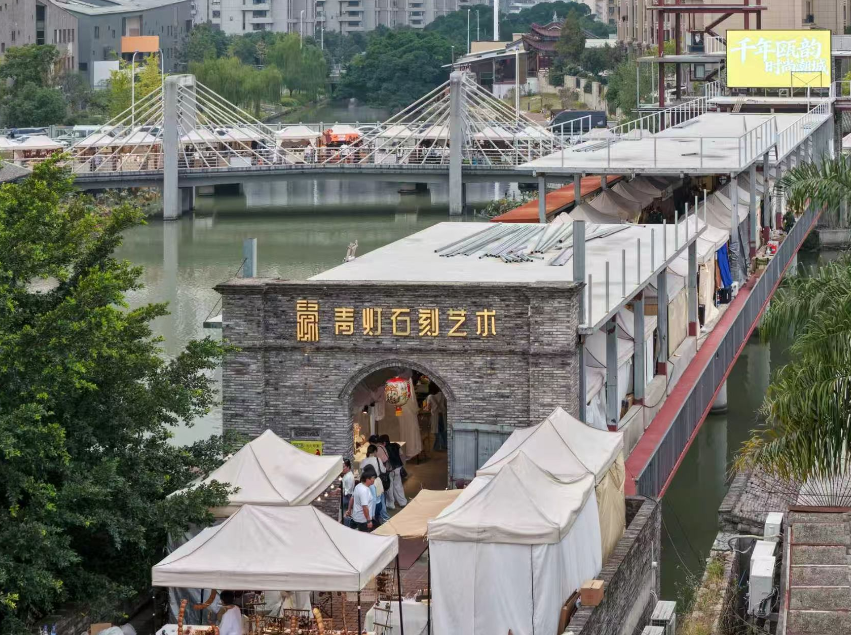
On October 27, the six-day 2026 Qingdeng Market National Aesthetics Conference (Autumn Session) opened as scheduled. Under the theme “Where Qingdeng Sings, the World Resounds”, the event brought together more than 1,000 vendors from the lifestyle and aesthetics sectors at home and abroad, showcasing more than 1,500 brands. This gathering of folk aesthetics, which grew organically on the banks of the Tanghe River, reached a landmark milestone this year: the International Organization for Folk Art officially awarded the Qingdeng International Art Community the title of the World’s First Global Partner for the Safeguarding and Living Heritage of Handicrafts.
From a private museum rescuing old bricks and stonework from the historic city centre, to a national aesthetics market bringing together thousands of brands, and then to a cultural hub connected to the global handicrafts network, Qingdeng’s six years of development have illuminated a new contemporary path for traditional handicrafts — from “archived preservation” to “living inheritance”, and from “rooted locally” to “connected globally”.
Collecting Old Bricks, Preserving Heritage
Revitalizing Living Inheritance Amid Civic Life
Qingdeng began with a deliberate effort to salvage urban memory. Years ago, Zhang Jincheng and his team visited more than 700 demolished villages across Wenzhou, rescuing, brick by brick, ancient stonework and paving slabs from the Ming and Qing dynasties that were about to be buried by bulldozers. Some 800,000 pieces of old-town masonry were used to build the original museum, which later expanded into five museums on both banks of the Tanghe River, forming a museum cluster covering approximately 130,000 square metres. Inside the Qingdeng Stone Carving Art Museum, tens of thousands of stone relics dating from the Five Dynasties to the Qing Dynasty are not sealed behind glass. Most are open for visitors to touch. Every stone and brick can be traced back to the village and old residence to which it once belonged. Zhang Jincheng remarked: “The true value of cultural relics lies not in how ancient they are, but in whether they can still connect with people today.”
Museums address the question of “preservation”, while the market makes “inheritance” possible. The Qingdeng Market was created to bring intangible cultural heritage and handicrafts out of the “confined museum halls” and into the “boundless world”. Wandering through the market, visitors can encounter impromptu performances of traditional opera among stalls selling tea ware, woodwork and paper art, returning opera to the streets where it was born eight centuries ago. Young Ou kiln artisans throw clay on the wheel before live audiences and invite visitors to touch it. Zeya bamboo paper is reimagined as tea hangings and journal pages, finding its way back onto modern desks.
Across China, Hangzhou has transformed the Tongyi Gong Spinning Mill into a Living Handicraft Museum, drawing on the Grand Canal World Heritage Site, while Jingdezhen has gathered tens of thousands of creators around Taoxichuan. Both follow the path of “heritage plus urban renewal”. What makes Qingdeng distinctive is that it has neither a World Heritage designation nor ready-made old factory buildings to repurpose. Instead, it is an organic model of living heritage that has grown from grassroots strength under the overall planning of urban cultural spaces.
As they move from stall to stall beneath the market lanterns, visitors discover an international art community quietly taking shape. It is home to more than 40 Chinese and international aesthetics brands and artists’ studios from several countries. Artists from France, Germany, Iran and elsewhere have settled here, alongside 15 high-quality cultural IPs, including Palace Cats, Zhejiang-style guqin (a traditional seven-stringed Chinese zither) and Shanxi murals. Even outside market periods, regular gatherings for dongxiao (a traditional Chinese vertical bamboo flute), guqin and other refined arts continue. Artisans from around the world create and exchange ideas here throughout the year, bringing to life a “Qingdeng That Never Ends”.
Lantern Light Linking the Four Seas
Cultural Resonance Forged by Craftsmanship
The reporter learned that the title awarded by the International Organization for Folk Art followed more than a year of in-depth reviews. Senior representatives from regions around the world made repeated visits to examine the complete model of “museum + aesthetics conference + international art community”. “We have visited countless museums and art festivals. We chose Qingdeng not for its scale, but for its exploration of a sustainable model,” said Chen Ping, Global President of the International Organization for Folk Art. “Safeguarding handicrafts cannot rely solely on collection and display. Artisans need markets, opportunities for exchange and conditions for continuous creation. Qingdeng brings all these elements together, enabling traditional crafts to become part of modern life.”
These words capture the distinctive value that sets Qingdeng apart from most commercial markets: it brings cultural collection, public participation, handicraft trading and artistic creation together in one space, sustained by grassroots initiative. This public engagement and market vitality are precisely what traditional handicrafts most need for sustainable development.
Indeed, this grassroots approach has always resonated with Wenzhou’s local handicrafts ecosystem. In 2023, the World Summit of the 50 Handicrafts Forum released the Wenzhou Declaration in Wenzhou. In 2024, the follow-up exchange event Art of the Maritime Silk Road was held at Qingdeng. In 2025, Wenzhou gained 14 newly recognised national-level representative inheritors of intangible cultural heritage, placing it first in Zhejiang Province and among the leading cities nationwide. The city’s long tradition of hundreds of crafts, its growing cohort of inheritors and its open, vibrant grassroots cultural environment have supplied Qingdeng with a steady stream of artisans, local creative inspiration and platforms for industrial exchange. This has enabled a local market to develop step by step into a living heritage hub connected to the global folk art network.
The theme of this year’s conference — “Where Qingdeng Sings, the World Resounds” — is not a one-way effort to “tell Chinese stories in a global language”. Instead, it represents equal dialogue and mutual resonance among the craft traditions of different civilisations. Fang Rujiang, a renowned Ou Opera performer, has established his master’s studio within the Qingdeng International Art Community. He notes: “’Harmony Shared Across the World’ does not mean diluting our local roots to cater to others. On the contrary, the deeper our roots, the stronger our cross-cultural appeal.” Today, the vocal art of Southern Opera (Nanxi, an early form of Chinese opera) stands alongside artistic creations from around the world. The daily exchange and mutual learning among creators offer the most vivid grassroots interpretation of “harmony shared across the world”.
Before this session, 11 editions of the Qingdeng Market had been held consecutively since 2020, attracting more than 5 million visitors and generating total sales of over 400 million yuan. “Museums collect objects; conferences gather people; communities nurture ecosystems,” Zhang Jincheng explained. These three pillars share a single vision: “Build a cultural platform through museum practice, and develop a world-class private museum through the platform.” He added that the International Organization for Folk Art’s network, which spans more than 160 countries, serves both as a channel for bringing global resources in and as a route for expanding overseas. Once the international art community matures, Qingdeng will lead its resident artists and brands to engage with global hubs as an integrated group.
This year, the International Organization for Folk Art also brought the 7th “Creative 100” Youth Creative Design Training Programme to Qingdeng. Twenty-five young participants from mainland China, Hong Kong and Macao came here to study, conduct field research, interact with artisans and explore contemporary innovations in traditional crafts. “Qingdeng shows us that traditional handicrafts can not only be preserved in museums, but also gain vitality in the market, thrive within communities and move towards the future through young creators,” Chen Ping said.
Cultural inheritance and exchange ought to be just like this: born among the people, lived in daily life, flowing quietly and steadily, with the lanterns burning on without end.