

The newly opened Mi-su & She-embroidery Heritage Hall has brought two of Wenzhou's own intangible cultural crafts — Mi-su, the rice-paste sculpture, and She ethnic embroidery — into the rammed-earth walls of the Jiaoyang Earth Building in Taishun. The old, once-idle fortress is being worked back to life: heritage by day, food and nightlife by dark, wellness and study tours to fill the off-season — proof, its custodians say, that the best way to keep an old building is to let it be used.
The character of the place is written in its walls. Rammed earth sits thick and ancient over a stone base; old timber frames the rooms; She-embroidery fabrics and Mi-su sculptures line the display spaces, each craft given its own corner of the homestead. "Bringing Taishun's Mi-su and She embroidery into the Earth Building is how I want this culture to root itself in old architecture, to become one with such a beautiful building," says Zhang Tianqing, city-level representative inheritor of the Mi-su craft. His plan is to fold local motifs — Taishun's covered bridges among them — into new pieces of rice-paste work, then open study tours and hands-on workshops so more people can meet the craft.
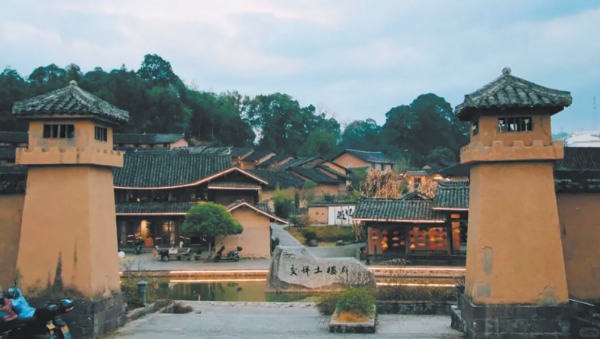
The building that now hosts them has a story almost two centuries long. Jiaoyang Earth Building stands in Shangjiaoyang village, Luoyang township, built in the Xianfeng reign of the Qing dynasty by the Zeng family after they moved up from the city of Quanzhou in South China’s Fujian province. A two-story square, walkway-ringed fortress — stone below, rammed earth above, a courtyard at its heart — it was raised to store grain and to defend, a rare surviving example of the Hakka square earth building in southern Zhejiang. Deeper archives round out the family's depth: the Zengs arrived around 1815, their flat-roofed Shuicheng House and the watchtower-cum-storehouse forming "a circle and a square," the pair spelling heaven (round) and earth (square); the clan is said to have produced one Imperial Military Graduate, nine Imperial Scholars and twenty-five Imperial Academy Students. On the walls of old houses, Qing-era official bulletins still pasted there tell the story of a bygone era..
Left empty and idle, the earthen fortress might have become nothing but a relic. Instead, Taishun has held fast to a simple principle: preserve by using. Of the complex's 17 courtyards, one granary building (Canglou) is reserved for conservation-only visits. The remaining 16 are each assigned a distinct role: intangible cultural heritage displays form the core of daytime cultural tourism; dining and night economy drive evening foot traffic; traditional Chinese medicine wellness and study programs fill the off-season; and several courtyards focus on local snacks and creative retail. Children join the "Young Heritage Inheritors" program, trying their hand at Taishun stone carving, time-honored incense making, cloisonné enamel, and rice dough sculpting. Meanwhile, senior study groups take a wellness route combining the Earth Building and Wenxiang Lake. Slowly, a fortress that once stored grain within its walls and kept strangers out is transforming into a living park — open for strolling by day, alive with activity by night.
Jiaoyang is not alone in Taishun. Upstream, Xu'aodi ancient village has built a "co-benevolent community" model uniting four parties, its eighteen historic buildings saved by emergency preservation and named a 2025 Zhejiang provincial case of high-quality cultural-relic development. Ku village, with more than 1,200 years of village life, has chosen "artistic rural revitalization" — restoring old houses, reviving folk dwellings and drawing in a crowd of "new villagers." Between them, the county keeps testing the same conviction: the most alive heritage is the one being lived in.