

To thoroughly implement the guiding principles from the 8th Plenary Session of the 15th CPC Zhejiang Provincial Committee, steadily advance the in-depth integration of culture and tourism, fully motivate young people to start businesses and pursue innovation in the cultural and tourism sector, and deliver new breakthroughs in building Zhejiang into a leading province in culture and tourism, the Department of Culture, Radio, Film, Television, Tourism and Sports of Zhejiang Province officially issued the Implementation Plan for Youth Entrepreneurship in Cultural Tourism in Zhejiang Province on December 22, 2025, together with the first batch of youth entrepreneurship cultural tourism cases.
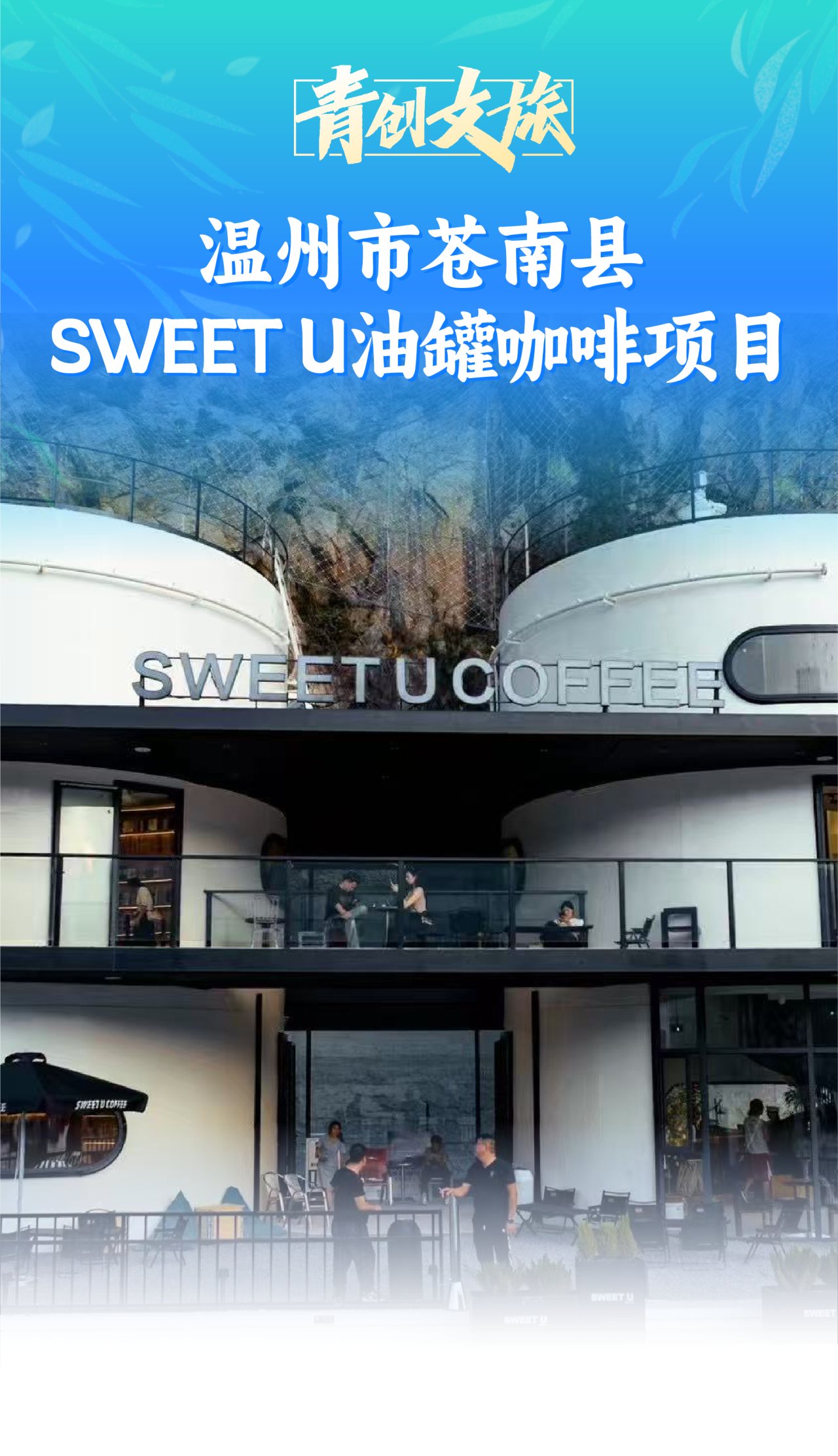
The first batch of cases fall into six categories: village-enterprise collaboration for common prosperity, youth cluster innovation, lifestyle aesthetics creativity, innovative experience scenarios, revitalization of idle resources, and activation of local culture. This installment of our Youth Entrepreneurship in Cultural Tourism series features a typical case under lifestyle aesthetics creativity — the SWEET U Oil Tank Coffee Project in Cangnan County, Wenzhou City.
Nestled in the Shipeng area of Jinxiang along Cangnan’s 168-kilometer Golden Coastal Tourism Line, SWEET U Oil Tank Coffee covers a total construction area of approximately 600 square meters. It was reconstructed from two decades-old abandoned offshore oil storage tanks formerly owned by Sinopec Zhejiang Petroleum Wenzhou Branch.
Adhering to the core principle of minor renovation and major upgrading, the project fully preserves the original industrial texture of the oil tanks and their landmark status along the coastline. The two giant tanks have been transformed into two complementary functional spaces: one is an industrial-style coffee house with a three-story Loft layout, whose top-floor sea-view seating offers unobstructed panoramic views of mountains and sea along the 168-kilometer Golden Coastal Tourism Line; the other houses a public library with over 10,000 books, featuring an artistic spiral staircase that has become a signature photo spot.
Supported by a coastal viewing platform and leisure trails, the project has evolved into a composite youth entrepreneurship hub integrating coffee experience, reading and leisure, youth socializing, and cultural and creative product displays.
Since its opening in October 2024, the venue has quickly become an internet-famous attraction, receiving nearly 300,000 visitors. Its turnover exceeded 3 million yuan in the first three months of operation, and reached about 7.5 million yuan by the end of 2025, with a net profit of 4 million yuan. As a landmark internet-famous cultural tourism site in Wenzhou, it has directly driven revenue growth of over 35% for surrounding catering, homestays and fishing tourism businesses.
Breaking industry barriers and property right restrictions, the project has established a four-party linkage system: government overall coordination, central enterprise empowerment, state-owned enterprise platform building, and youth team operation. This model addresses common bottlenecks in industrial heritage revitalization, including unclear property rights, funding shortages and lack of professional operation teams.
Cangnan County has listed the project as a key county-level cultural tourism initiative and a youth entrepreneurship demonstration project, and set up a multi-department joint service task force. The county tourism investment group has forged in-depth strategic cooperation with Sinopec: Sinopec revitalizes idle assets and provides technical support and safety standards for industrial reconstruction; leveraging its operational strengths along the 168-kilometer Golden Coastal Tourism Line, the county tourism investment group takes charge of project positioning, design, renovation and resource integration.
The two parties formed a joint task force with shared decision-making, coordinated progress and shared risks, realizing deep integration and mutual empowerment between idle central enterprise assets and local cultural tourism creative operations.
Following the principle of protection first and rational utilization, the project maximizes space value with minimal intervention, turning industrial "rust belts" into cultural tourism "vibrant belts". It retains industrial elements such as steel structures and tank contours to preserve the historical memory of coastal industrial development and fishery evolution. Meanwhile, modern cultural tourism formats are introduced to make efficient use of idle resources and maintain and increase the value of state-owned assets through low-cost renovation.
The renovated oil tank coffee retains the rugged industrial character while boasting a warm literary and recreational vibe. Thanks to this low-investment, high-creativity renovation model, the upfront investment for youth entrepreneurship has been cut by more than 60%, delivering two-way gains for industrial heritage protection and cultural tourism development.
The project innovates an operational model of state-owned enterprise investment in construction plus professional operation by youth entrepreneurial teams, with operation planning carried out in advance to fully unleash youth innovation vitality. The Cangnan County Tourism Investment Group covers civil engineering and hard decoration costs, while the youth lead team headed by Li Shanwei participates fully in design, construction and operation, forming a virtuous cycle of renovation — operation — value appreciation — reinvestment.
The youth team accurately captures market trends: it launched creative packages such as swimming crab paired with coffee under the "coffee + local specialties" model; hosted cultural events including pop-up performances under the Literary Beauty Program; and built a brand IP via new media matrix tailored to young audiences, rapidly boosting online traffic.
At its core, the project has built a collaborative mechanism featuring government guidance without overreach, state-owned enterprise support without absence, and youth leadership without misalignment, resolving long-standing pain points of ambiguous power and responsibility and insufficient motivation in traditional cultural tourism projects. The government focuses on policy support and environment optimization, removing implementation obstacles via task force services; state-owned enterprises shoulder heavy-asset investment risks to lower the startup threshold for young entrepreneurs; youth teams take charge of light-asset operation and brand building, with a revenue-sharing mechanism fully stimulating creative vitality.
This risk-sharing and benefit-sharing model preserves and increases the value of state-owned assets while building a low-threshold, high-support platform for youth entrepreneurship, achieving balanced benefits for all stakeholders.
Upholding the philosophy of minor input, quick output and high returns, the project has blazed a sustainable path for industrial heritage resource utilization, value commercialization and industrialized benefits. Through minor renovation and major upgrading, decades-long dormant industrial assets have been transformed into high-value cultural tourism scenes at low cost.

Driven by both localization and youth-oriented development, the project integrates Cangnan seafood culture, industrial memory and trendy coffee culture to build differentiated core competitiveness.
It has created a positive loop where youth entrepreneurship generates local jobs and project growth fuels rural development. The project directly employs more than 20 young local residents, and purchases local seafood worth 1.2 million yuan every year. It has spurred the opening of 3 new homestays and 26 new catering and retail stores nearby, and created jobs including parking management, tourist shuttle services and cleaning for local villagers. Over 60 households have seen income growth, with an average annual increase of more than 20,000 yuan per household.